

SEO Isn’t Dead. But It’s Not Enough Anymore.
Let me tell you about a conversation I had last week.
I was helping my nephew with his homework. He’s twelve. He needed to know why the Roman Empire fell.
When I was his age, I would’ve gone to the library. Or maybe asked my parents. Or if I was lucky, used Encarta on the family computer.
He pulled out his phone and said “Hey ChatGPT, why did the Roman Empire fall?”
Two seconds later, he had a paragraph. Clear. Concise. No links to click. No websites to visit. Just an answer.
That’s not search. That’s something else entirely.
And it changes everything about how businesses need to think about visibility.
Welcome to the world of GEO vs. SEO. Generative Engine Optimization versus Search Engine Optimization.
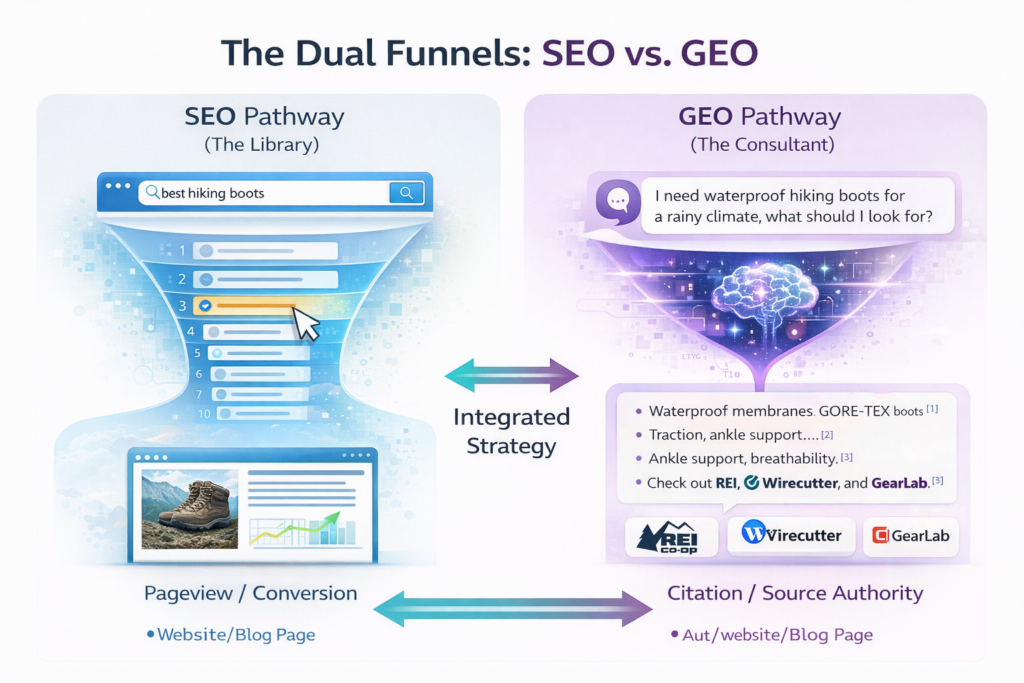
One is about ranking in a list of links. The other is about being cited in an AI’s answer.
And if you’re only doing the first one? You’re already behind.
The Old Way vs. The New Way
Let me break this down simply.
SEO is like a library. You organize your books. You make sure they’re on the right shelves. You hope someone walks down the aisle, sees your book, and pulls it off the shelf.
GEO is like having a really smart consultant. Someone asks a question. The consultant thinks “I know exactly who has the answer to that.” Then they quote you directly.
Same goal—being found. Completely different path to get there.
According to a study by Gartner published earlier this year, generative AI engines are already reshaping how nearly a third of internet users find information. That number is climbing fast. And here’s the kicker—traditional search traffic is starting to decline as a result.
So when we talk about GEO vs. SEO, we’re not talking about one replacing the other. We’re talking about a fundamental shift in where attention is going.
How I Learned This Lesson the Hard Way
I had a client last year. Financial advisor. Really smart guy. Wrote incredible content about retirement planning.
His SEO was solid. Top three rankings for half a dozen key phrases. He was happy.
Then he started noticing something weird. His traffic was holding steady, but his calls were dropping. People were visiting his site, reading his content, and then… nothing.
I couldn’t figure it out.
Then I asked Siri “how much do I need to retire comfortably?”
The answer came from a generic financial website. Not my client. And the answer was fine. It was correct. It was just… generic.
My client’s content was better. More detailed. More accurate. But Siri didn’t know that. Because his content wasn’t optimized for how AI thinks.
That’s when I started studying GEO vs. SEO in earnest. And everything changed.
What Actually Matters Now
Okay, let me tell you what I’ve learned.
First, authority isn’t just about backlinks anymore. It’s about clarity.
When an AI reads your content, it’s not looking for fancy words or clever turns of phrase. It’s looking for clear, definitive statements. Answers that leave no room for doubt.
Back in 2023, researchers at Princeton and UPenn published a paper showing that generative AI models prefer content that is “well-structured, factual, and unambiguous.” That sounds obvious. But most websites aren’t built that way.
Second, structure matters more than length.
I used to write 3,000 word articles because Google loved long content. And Google still does, sort of.
But ChatGPT? Gemini? Copilot? They don’t care about word count. They care about whether they can find the answer quickly.
Use headings that actually say something. “Why the Roman Empire Fell” not “Causes of Decline.” Be specific. Be direct.
Third, you need to answer follow-up questions before they’re asked.
This is the secret sauce of GEO.
When a human reads your article and has a question, they keep reading. Or they scroll. Or they click another link.
When an AI reads your article and has a question? It moves on to another source. And you lose the citation.
So anticipate. If you’re writing about retirement savings, include a section on “what if I start late?” If you’re writing about hiking boots, include a section on “how do I know when to replace them?”
Answer the questions people don’t know they have yet. That’s how you become the source the AI trusts.
A Client Who Nailed This
Let me tell you about a different client. Home improvement contractor. Wrote articles about roofing, windows, siding.
After we learned about GEO vs. SEO, we completely changed his approach.
Instead of writing general “how to choose a roofer” articles, we wrote specific, definitive guides. “What a roofing estimate should include.” “Three questions to ask before hiring a roofer.” “The exact warranty language you want to see.”
We structured every article with clear headings that stated conclusions. We added FAQ sections that anticipated follow-ups. We made his 20 years of experience impossible to miss.
Within four months, something interesting happened.
His SEO rankings didn’t change much. Still top five for most keywords.
But his phone started ringing more. People would call and say “I was asking my phone about roofing and your name came up. You said X, Y, and Z. Is that right?”
They weren’t finding him on Google. They were finding him through AI. And they were calling because the AI had already pre-sold them on his expertise.
That’s the power of GEO.
What You Need to Do Right Now
Let me give you a practical checklist.
First, audit your content for clarity.
Pick your five most important pages. Read the first paragraph of each. Does it answer a specific question directly? Or does it dance around?
If it’s dancing, rewrite it. State the answer. Then explain the answer. But state it first.
Second, add definitive headers.
Scroll through your content. Are your headings boring? “Introduction” “More Information” “Conclusion.”
Change them. “Why Most Roof Estimates Are Wrong” “The One Warranty Clause That Matters” “When to Walk Away From a Contractor.”
Make every heading a mini-answer.
Third, anticipate follow-ups.
At the end of each article, add a “you might also wonder” section. List three to five questions someone might have after reading. Answer them briefly.
This tells the AI that your content is comprehensive. That you’ve thought about the whole conversation, not just the first question.
Fourth, make your expertise visible.
Don’t bury your credentials in an about page. Put them on every article. “John Smith, Master Electrician with 22 years of experience.” Right at the top.
AI models are trained to prioritize authoritative sources. Make it impossible for them to miss yours.
The Bottom Line
Look, here’s what I really want you to understand.
The debate of GEO vs. SEO isn’t about choosing sides. It’s about expanding your playbook.
SEO gets you found when people search.
GEO gets you cited when people ask.
You need both.
But most businesses haven’t even started thinking about GEO. Which means right now, the field is wide open.
The brands that figure this out first are going to own the AI conversation. They’ll be the ones quoted in every ChatGPT response. The ones mentioned in every Gemini answer.
The rest? They’ll be fighting over the scraps of traditional search while everyone else has moved on.