
Your Marketing Automation Is Working. So Why Does It Feel So… Robotic?
Let me ask you something honest.
You’ve got your CRM set up. Your email sequences are running. Leads are moving through the funnel. Everything works.
But something feels off, doesn’t it?
Because when you look at those automated emails, they sound… fine. They’re fine. The timing is fine. The content is fine.
But fine isn’t good enough anymore.
Because your customers? They’re getting hundreds of these “fine” emails every week. From every company they’ve ever touched.
And they’re tired of it.
The problem isn’t your automation. Automation is great. It’s necessary. It keeps the lights on.
The problem is that you’re using automation to do a job it was never meant for. You’re trying to make it feel human. And it can’t.
That’s where Smart Personalization comes in.
Let Me Tell You About the Last Time I Felt Truly Understood by a Brand
I was shopping for a backpack last year. Nothing fancy. Just something for my laptop and a few notebooks.
I visited a few sites. Looked at some options. Left without buying.
Then I went back to one of those sites a few days later. And something was different.
The homepage didn’t show me random backpacks anymore. It showed me the exact ones I had clicked on. Plus a few similar ones I hadn’t seen.
There was a little message that said “still thinking about the Nomad backpack? here’s 10% off.”
It wasn’t creepy. It wasn’t pushy. It was just… helpful.
I bought the backpack.
That wasn’t automation. That was Smart Personalization. The brand used what they knew about me to make my experience better. Not to stalk me. To help me.
Big difference.
What Most People Get Wrong About Personalization
Here’s what drives me crazy.
A company puts your first name in an email and calls it personalization.
“Hey John, we thought you’d like this.”
Come on. That’s not personalization. That’s a mail merge. We figured that out in the 1990s.
Smart Personalization is different. It’s not about inserting a name. It’s about inserting understanding.
It’s showing me the product I actually want, not the one you want to push.
It’s sending me an email about the topic I clicked on, not the one you blast to everyone.
It’s knowing that I just bought a coffee maker, so maybe don’t send me ads for coffee makers for the next six months.
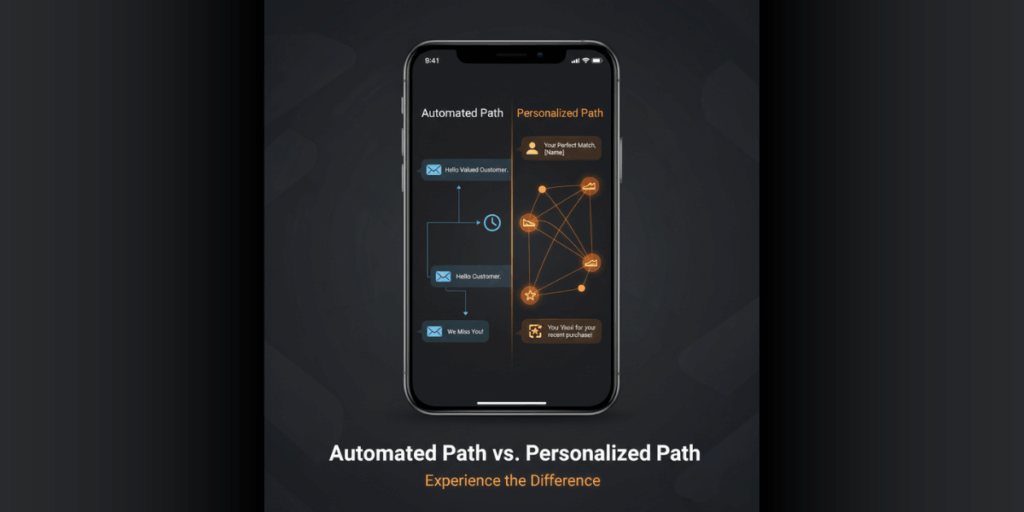
Automation asks “what time is it?”
Smart Personalization asks “what time is it for this specific person right now?”
See the difference?
The Real Problem With Most Marketing Right Now
I see this all the time.
A business sets up an automated welcome sequence. Five emails. Spread out over two weeks.
Everyone who signs up gets the exact same five emails. Whether they’re a small business owner or an enterprise CMO. Whether they signed up for a webinar or downloaded a white paper. Whether they opened the first email or ignored it completely.
That’s not marketing. That’s just noise.
And customers have gotten really good at ignoring noise.
Smart Personalization flips that. It says “wait, let me look at this person. What do I actually know about them? What do they actually need?”
Then it acts on that.
Not because it’s fancy. Because it works.
Let Me Give You Some Real Examples
I worked with an e-commerce client last year. Sold outdoor gear.
Their automation was fine. Abandoned cart emails. Welcome sequences. The usual.
But sales were flat. So we added some Smart Personalization.
First, we changed the website. When someone came back to the site, the homepage showed them the last three products they looked at. Right at the top.
Simple. But effective. Click-through rates on those product recommendations were three times higher than on the generic ones.
Second, we changed the emails. Instead of sending the same abandoned cart email to everyone, we personalized based on what was in the cart.
If someone abandoned a tent, the follow-up email showed camping accessories. If someone abandoned a jacket, the follow-up showed hats and gloves.
Relevance went through the roof.
Sales went up 18% in two months. No new traffic. No new products. Just smarter personalization.
Where’s the Line? When Is It Cool vs. Creepy?
This is the question everyone asks me.
And honestly, it’s a good one. Because there’s a fine line between helpful and weird.
Here’s my rule. Personalization is cool when it helps me. It’s creepy when it feels like you’re watching me.
Showing me products I looked at? Helpful.
Mentioning my city in an email when I never told you where I live? Creepy.
Suggesting a product based on my purchase history? Helpful.
Sending me a notification that “we noticed you were on our site for 17 minutes”? Creepy. Don’t do that.
The difference is value. Am I getting something useful from this? Or does it just feel like you’re tracking me?
If you can’t answer that question confidently, don’t do it.
How to Actually Make This Work
Alright, let me walk you through the practical stuff.
First, stop trying to personalize everything.
You don’t need Smart Personalization on your contact page. You don’t need it on your about us page.
Focus on the high-impact moments. Welcome sequences. Product recommendations. Cart abandonment. Pricing page visits.
Those are where personalization moves the needle. Everything else? Automation is fine.
Second, let automation do the boring work.
Your automated systems should be collecting data. What pages people visit. What emails they open. What they buy. What they ignore.
That’s the fuel for personalization. Without it, you’re guessing.
Third, feed that data into your personalization engine.
This is where most people drop the ball. They have the data. They just don’t use it.
Take what you know about a user and actually do something with it. Change the website. Change the email. Change the offer.
Don’t just collect data to collect data. Use it.
Fourth, create trigger moments.
This is the advanced stuff. And it’s where Smart Personalization gets really powerful.
Set up rules that say “if someone does X, then trigger Y.”
Example. Someone visits your pricing page three times in one week. That’s a signal. They’re interested but hesitating.
A smart system would see that and automatically trigger a personalized offer. Or route them to a salesperson. Or send a targeted email addressing whatever objection they might have.
That’s not automation. That’s intelligence.
The Bottom Line
Look, here’s what I really want you to understand.
Automation is not the enemy. You need it. It scales. It saves time. It makes sure nothing falls through the cracks.
But automation alone feels like a robot. Because it is a robot.
Smart Personalization is what makes that robot feel like a human. It adds context. It adds relevance. It adds understanding.
You need both. Automation for the backbone. Personalization for the soul.
Stop asking “how do I automate this?” Start asking “how do I make this feel human at scale?”
That’s the difference between marketing that works and marketing that actually connects.