
Google Just Changed the Game. Have You Noticed?
Let me tell you something that’s keeping me up at night.
For the last ten years, the goal was simple. Get your website on the first page of Google. Preferably in the top three spots. Those blue links. That was the whole ballgame.
But something weird started happening last year.
I was searching for “how to fix a leaky faucet” and Google just… told me the answer. Right at the top of the page. No links to click. Just a paragraph. A few bullet points. Done.
I didn’t click anything. I just read the answer and moved on with my life.
That’s never happened before.
And it’s happening more and more. Every day. For more and more searches.
Welcome to the rise of AEO. Answer Engine Optimization.
It sounds fancy. It’s not. It just means Google isn’t sending people to websites anymore. It’s pulling answers from websites and showing them directly on the search page.
Which means if your content isn’t structured to be one of those sources? You’re invisible.
Let Me Explain What Just Happened
Remember how Google used to work?
You’d type a question. Google would show you ten blue links. You’d click one. Read the page. Maybe click back and try another one.
That was the deal. Google sent you traffic. You sent Google content. Everyone was happy.
Now? Type the same question. Google just gives you the answer. No click required.
Where does that answer come from? Your website. Probably. If you’re lucky.
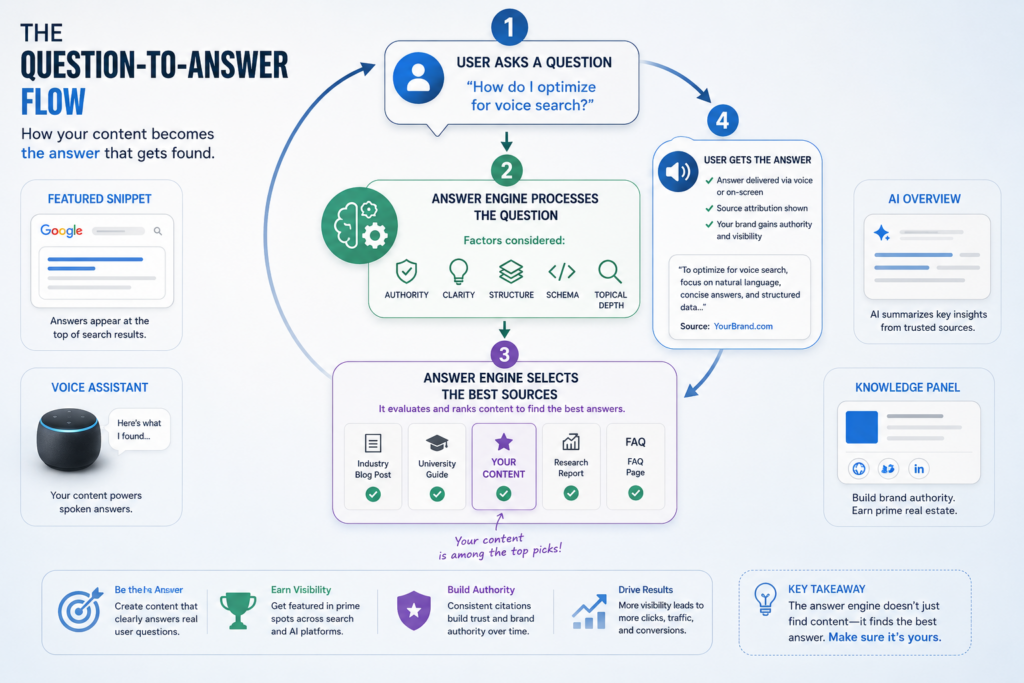
Google’s AI reads through dozens of websites. It pulls out the best answer. It synthesizes information from multiple sources. Then it presents that answer right there on the search page.
The user never leaves Google. The user never clicks your link. The user never sees your website.
So you did all that work. You wrote that great article. And you got… nothing.
That’s the rise of AEO. And it’s terrifying for businesses that haven’t adapted.
The First Time I Realized Something Had Changed
I was doing a routine audit for a client. Law firm. They wrote great content. Detailed articles about personal injury law. Really thorough stuff.
Their rankings were actually pretty good. Top five for most of their target keywords.
But their traffic was down. Way down. Month over month.
I couldn’t figure it out. Their rankings hadn’t changed. Their site was still fast. Everything looked fine.
Then I searched for one of their target keywords. “What to do after a car accident.”
At the top of Google? An AI Overview. Six bullet points. All the key information. Right there.
My client’s article was the third result below that overview. But nobody was scrolling down. They got their answer from the AI and left.
That’s when it clicked. Traditional rankings don’t matter anymore if the AI is stealing all the clicks.
So What Actually Is AEO?
Let me break this down simply.
SEO was about getting Google to list your website.
AEO is about getting Google to use your content to build answers.
Different goal. Different tactics. Different mindset.
With SEO, you wanted to be one of ten blue links.
With AEO, you want to be one of the three sources Google trusts enough to quote.
With SEO, you wrote for humans who would click and read.
With AEO, you write for AI that will scan and extract.
With SEO, you competed against other websites.
With AEO, you’re trying to earn the trust of an algorithm that never sleeps.
The rise of AEO means you’re no longer just optimizing for people. You’re optimizing for machines that serve people.
It’s weird. But it’s where we are.
What Google Is Actually Looking For
Okay, let me tell you what matters now.
Because it’s not the same as before.
First, Google wants definitive answers.
Not “here’s what some people think.” Not “there are several ways to approach this.”
Google wants a clear, direct, confident answer. The first paragraph of your article should answer the question. Immediately. No fluff. No stories. No “let’s dive in.”
If someone asks “how long does it take to boil an egg?” your first sentence should be “it takes about 10-12 minutes to hard boil an egg.”
Not “eggs are a nutritious food that have been enjoyed by humans for centuries.” Just the answer.
Second, Google wants structure.
If your content is just a wall of text, the AI can’t parse it. It doesn’t know where one idea ends and another begins.
Use headings. Use bullet points. Use numbered lists. Use tables if appropriate.
Make it easy for the AI to find the specific piece of information it’s looking for.
Third, Google wants authority.
This one hasn’t changed. But it matters more now.
Because if Google is going to put your answer in front of millions of people, it needs to be sure you’re not wrong.
That means credentials. Experience. Original research. Links from other trusted sites.
If you’re a plumber writing about plumbing, say you’re a plumber. “With 15 years of experience fixing leaks…” That matters now.
A Client Who Figured This Out
I worked with a nutritionist last year. She had a blog with really detailed articles about diet and health.
But her traffic was dropping. Same problem. AI Overviews were stealing her clicks.
So we pivoted to AEO.
First, we restructured her articles. Every article started with a clear, direct answer to the main question. No stories. No fluff. Just the answer.
Second, we added schema markup. Fancy name. Simple idea. It’s code that tells Google “this is a recipe, this is a list of ingredients, this is the cooking time.”
Third, we made her expertise obvious. Every article had a byline that said “by Jane Smith, Registered Dietitian with 12 years of clinical experience.”
Within three months, something interesting happened.
Her traffic didn’t recover to where it was. But her visibility did. She started seeing her name quoted in AI Overviews. Not just her website. Her name.
People would search for nutrition questions, see Jane’s answer in the AI Overview, and then search for her specifically.
She didn’t get the click. But she got the credit. And that credit turned into clients.
That’s the new game.
What You Need to Do Right Now
Let me give you a to-do list. Not fancy stuff. Just things that work.
First, look at your most popular content.
What questions are you answering? Are you answering them directly in the first paragraph? If not, rewrite it.
Second, add FAQ schema.
This is low-hanging fruit. There are plugins that do this for you. It tells Google “this is a question and this is the answer to that question.”
Third, make your expertise obvious.
Put your credentials everywhere. If you have awards, certifications, years of experience, put them on the page. Google needs to know why it should trust you.
Fourth, target question-based keywords.
“What is…” “How do I…” “Why does…” Those are AEO gold. Write articles that answer those specific questions. Not general topics. Specific questions.
The One Thing You Should Stop Doing
Stop writing articles that dance around the answer.
You know what I mean. The ones that say “there are many factors to consider when asking how long to boil an egg. Eggs come in different sizes. Altitude affects cooking time. Some people prefer runny yolks while others prefer firm.”
Just answer the question. Then explain the nuance. But answer first.
Because the AI isn’t going to read your whole article. It’s going to scan the first paragraph. If the answer isn’t there, it’s moving on to someone else’s site.
The Bottom Line
Look, here’s what I really want you to understand.
The rise of AEO isn’t going away. Google isn’t going to stop showing AI answers. If anything, they’re going to show more.
You can’t fight it. You can’t ignore it. You have to adapt.
But adaptation isn’t that hard. It’s just different.
Write clear answers. Structure your content. Prove your expertise. Make it easy for machines to understand you.
That’s it.
The businesses that figure this out first are going to win. Because they’ll be the ones Google trusts. They’ll be the ones quoted in every AI Overview.
The ones that don’t? They’ll wonder why their traffic disappeared and never figure out why.