

For years, the pillars of good User Experience (UX) have been speed, accessibility, and intuition. But a new, non-negotiable pillar is emerging from an urgent global conversation: sustainability. The websites we build and visit have a tangible, physical cost, consuming vast amounts of energy in data centers and transmission networks. Today, forward-thinking designers and developers are realizing that eco-friendly web design isn’t just an ethical niche—it’s fast becoming the new UX standard. Creating a sustainable website inherently creates a superior, more inclusive, and more efficient experience for everyone.
The Invisible Cost of a Heavy Website
Every unnecessary image, unoptimized script, and autoplaying video requires data to be processed, transferred, and rendered. This energy consumption translates directly into carbon emissions. A bloated, slow website isn’t just a poor UX standard; it’s an environmental liability. The core principle of sustainability in this context is efficiency: delivering the maximum value with the minimum digital weight. This alignment of ecological and experiential goals is where the revolution begins.
How Sustainable Design Principles Elevate Core UX
The practices that define eco-friendly web design are, in practice, a masterclass in foundational UX optimization.
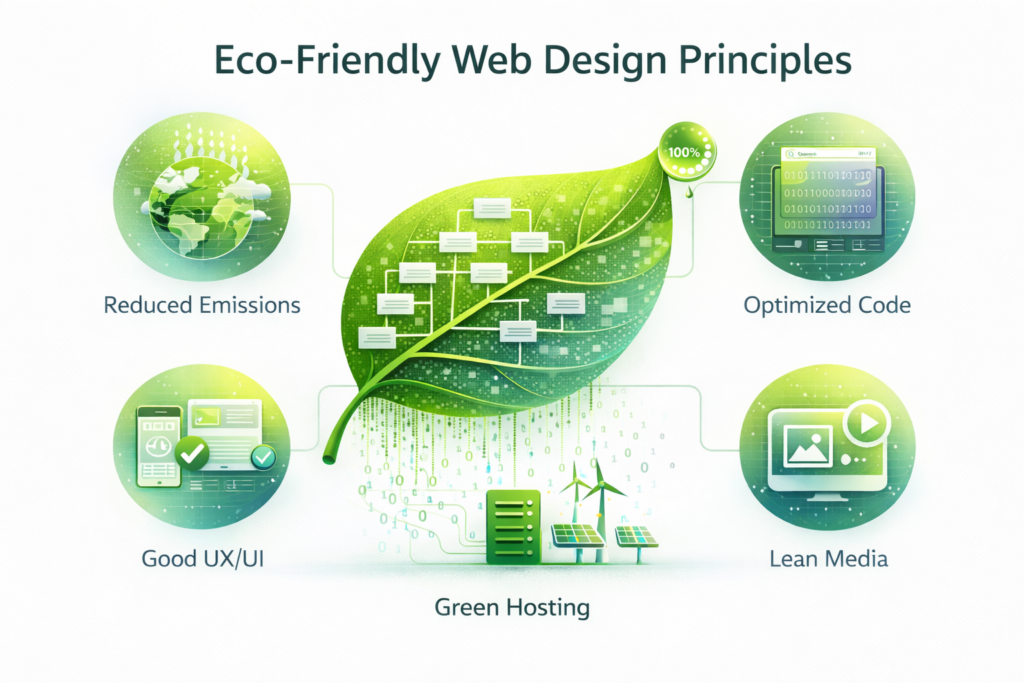
- Performance is Sustainability (and Vice Versa): The number one rule for reducing a site’s carbon footprint is to make it load faster. This involves image optimization (using modern formats like WebP), clean code, lazy loading, and eliminating render-blocking resources. The result? A dramatic improvement in core web vitals, lower bounce rates, and higher conversion—all while using less energy. A fast site is a sustainable site, and both are the hallmark of a great user experience.
- User-Centered Design Meets Intentionality: A sustainable approach forces us to question every element. “Does this video autoplay benefit the user, or just drain their battery and data?” “Is this third-party tracking script essential, or is it bloat?” This intentionality leads to cleaner interfaces, less cognitive load, and more respectful user journeys. It champions the UX standard of clarity and purpose over decorative excess.
- Accessibility and Sustainability are Allies: Many principles overlap. Semantic HTML (good for screen readers) is also lightweight and efficient. Sufficient color contrast (good for visibility) can reduce the need for high-energy imagery. A site built for the broadest possible audience, including those on older devices or low-bandwidth connections, is inherently more sustainable and user-friendly.
Implementing the New Standard: A Practical Framework
Adopting eco-friendly web design as your UX standard doesn’t require a complete overhaul. It starts with mindful choices:
- Audit Your Digital Carbon Footprint: Use tools like Website Carbon Calculator or Ecograder to benchmark your current site’s impact.
- Choose a Green Host: Partner with a web host powered by renewable energy. This is the single biggest lever you can pull.
- Design with a “Less is More” Philosophy: Embrace white space, system fonts, and a restrained color palette. Use vector graphics (SVGs) instead of heavy images where possible.
- Empower User Choice: Give users control. Implement “dark mode” (which can save energy on OLED screens), allow them to disable animations, and avoid unnecessary data-fetching.
Conclusion: The Ethical and Business Imperative
Eco-friendly web design is no longer a fringe concern. It represents the maturation of our industry—a commitment to building a web that is not only functional and beautiful but also responsible. As users become more environmentally conscious, a sustainable site will become a key trust signal and competitive advantage. By integrating sustainability into the heart of our process, we stop seeing it as a constraint and start recognizing it as the ultimate UX standard: creating seamless, high-performance experiences that are good for people and the planet. The future of UX is green.