
The era of static software is closing. Today’s most transformative applications don’t just respond to clicks; they understand goals, make decisions, and execute multi-step tasks autonomously. This leap in capability is powered by Agentic AI: systems endowed with the ability to perceive, plan, and act to achieve objectives. For businesses built on custom web applications, this represents the ultimate evolution: turning your custom web app into an intelligent assistant. This is not about adding a chatbot overlay, but about fundamentally re-architecting your application’s core logic to include a proactive, reasoning agent that works alongside your users.
Beyond Automation: From Tool to Collaborative Partner
Historically, custom web apps have been sophisticated tools—they process data, manage workflows, and generate reports based on explicit user commands. However, they lack initiative and contextual understanding. Consequently, complex tasks still require significant manual orchestration. Therefore, Agentic AI introduces a paradigm shift: your application gains the ability to interpret high-level intent (“prepare the Q3 sales review”) and independently break it down into the necessary steps: fetching data, analyzing trends, generating visualizations, drafting narratives, and scheduling a presentation. This transformation means the software transitions from a passive instrument to an active, collaborative partner.
The Architecture of Agency: Core Capabilities
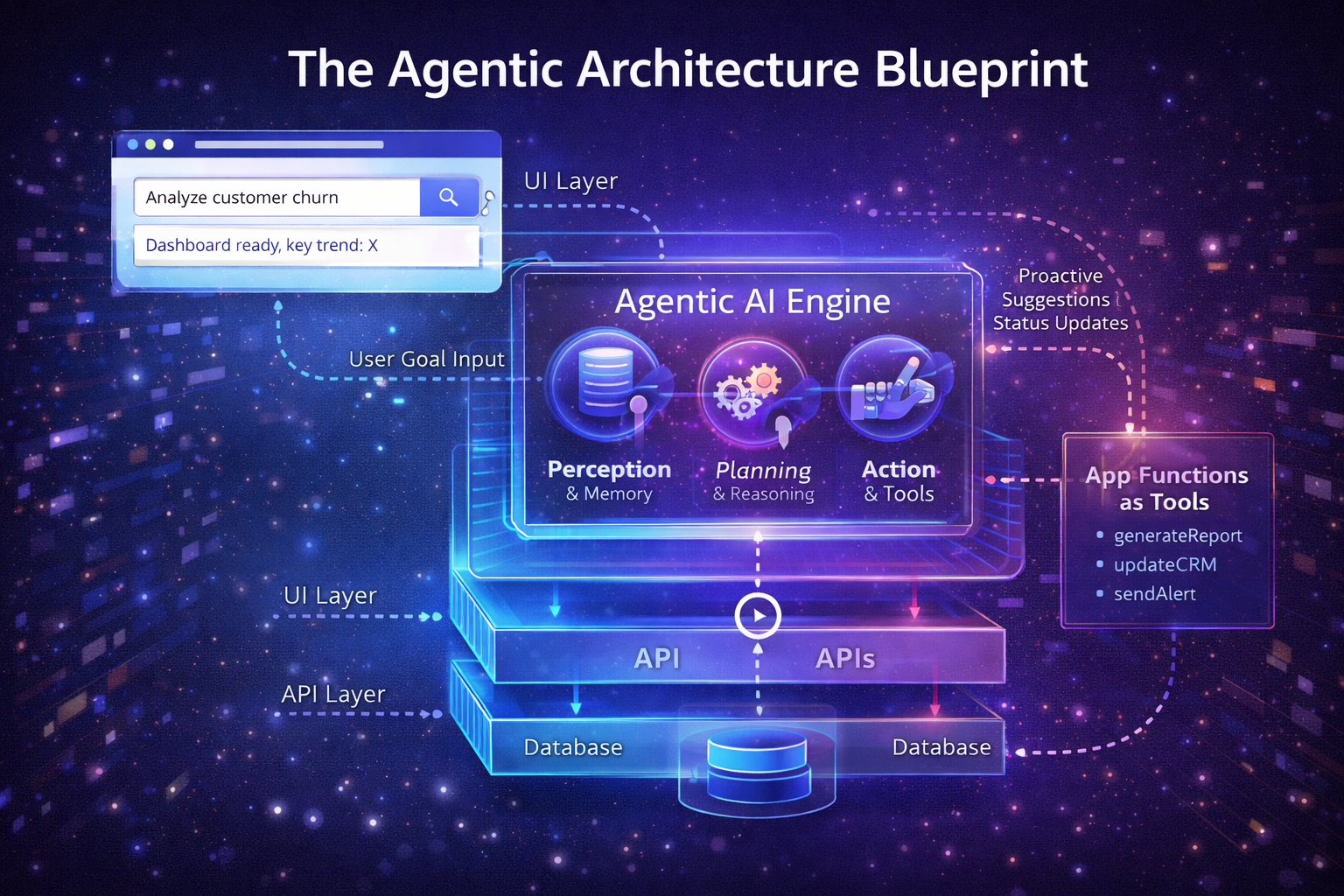
Essentially, turning your custom web app into an intelligent assistant requires infusing it with three key capabilities that mirror human-like reasoning.
- Perception & Memory (The Assistant’s Senses and Recall): The agent must have a rich, contextual understanding of its environment. This involves integrating access to your app’s database, user activity logs, relevant external APIs, and knowledge bases. Critically, it requires a memory—both short-term (the context of the current session) and long-term (learned preferences, past user interactions). This allows the assistant to say, “Based on last quarter’s approach, I’ve prioritized these metrics for your review.”
- Planning & Reasoning (The Assistant’s Thought Process): When given a goal, an agentic system doesn’t just follow a preset script. Instead, it constructs a dynamic plan. Using frameworks like Chain-of-Thought or Reasoning-Act, it breaks down the objective, evaluates conditions (“Do I have all the data?”), and sequences actions logically. If an obstacle arises, it can re-plan. For example, if an API is down during a data fetch, it can reason to use a cached snapshot and flag the issue for the user.
- Action & Tool Use (The Assistant’s Hands): An agent’s plans are meaningless without execution. Therefore, the system must be equipped with a set of tools—functions it can call to affect the world within your app. These tools can be core application functions (createInvoice, schedulePost, runAnalysis) or integrations (sendSlackMessage, queryCRM, fetchMarketData). The agent learns to select and use the right tool at the right time to advance its plan, effectively operating the application on the user’s behalf.
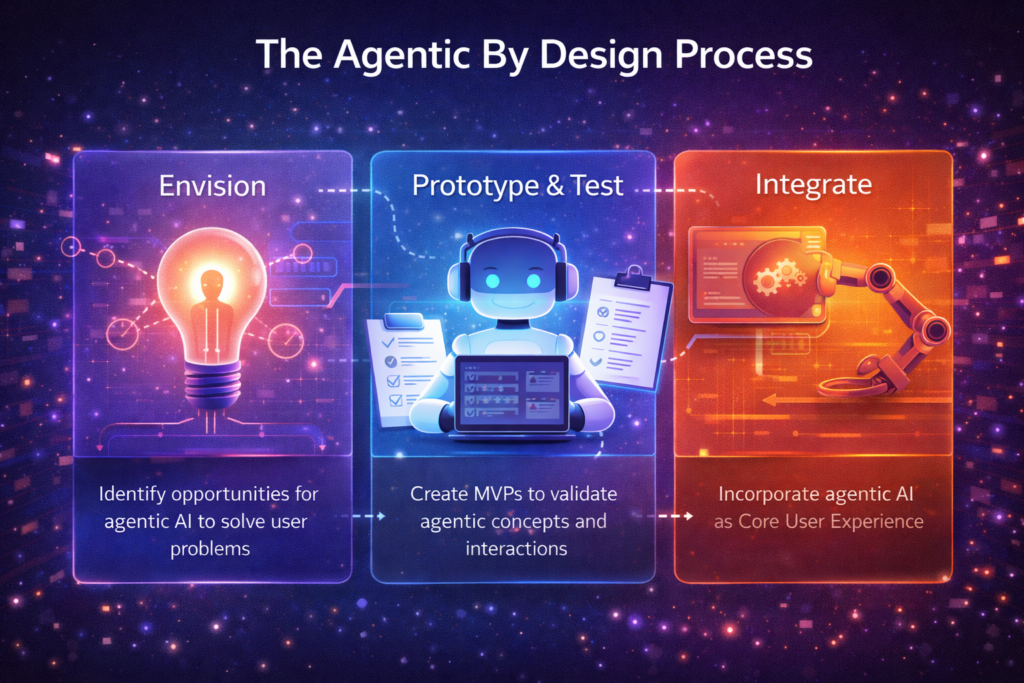
The Implementation Pathway: Building Your Digital Colleague
Adopting this technology is a strategic journey, not a simple plugin installation.
- Start with a High-Impact, Contained Workflow: Identify a single, complex but well-defined process within your app that consumes disproportionate manual effort (e.g., client onboarding, content moderation triage, multi-source report compilation). This becomes your pilot agent.
- Architect for Safety and Oversight: Agentic systems must operate within guardrails. Implement clear permission boundaries, confirmation steps for critical actions, and a comprehensive audit log of every decision and action taken by the agent. The user should always be in command, able to monitor, pause, or correct the agent’s work.
- Choose Your Foundation Wisely: Leverage powerful LLM APIs (like OpenAI’s GPT-4, Anthropic’s Claude) as the agent’s reasoning “brain.” Utilize agent frameworks (LangChain, LlamaIndex, AutoGen) to handle the orchestration of memory, planning, and tool use. Your custom web app provides the tools, data, and UI.
- Design the Interaction Model: How does the user delegate to and collaborate with the agent? This could be a natural language command bar, a “delegate this task” button on a dashboard, or an agent that monitors activity and proactively offers assistance. The interface must make the agent’s capabilities clear and its actions transparent.
Conclusion: The Dawn of Autonomous Software
Ultimately, integrating Agentic AI is the next logical step in the sophistication of custom software. It moves beyond feature automation to goal automation. By commit to turning your custom web app into an intelligent assistant, you unlock unprecedented levels of productivity, enable users to operate at a higher level of strategic thinking, and create a truly adaptive, self-improving system. In the end, the most powerful application is no longer just a reflection of your business logic coded into forms and buttons; it is an active participant in your business, capable of understanding, executing, and elevating the work to be done.