
We’ve all experienced the other kind of mobile personalization. You buy a lawnmower, and for weeks, your app notifications scream about lawnmower accessories. It’s not personal; it’s just a reminder of your past. It’s reactive, clumsy, and often irrelevant.
True AI-powered personalization is the opposite. It’s proactive, predictive, and feels less like marketing and more like a thoughtful assistant. It means your app doesn’t just react to what a user did; it anticipates what they need and adapts its entire experience accordingly—from the very first screen to the notifications that bring them back.
At Bright Bridge Web, we see AI-powered personalization not as a feature, but as the core operating system for any modern, successful mobile application. Let’s explore how this plays out across the user journey.
The First Impression: Dynamic Welcome Screens & Onboarding
The old way: A static, linear slideshow that every user swipes through.
The AI-powered way: An adaptive onboarding flow that changes based on who the user is.
- How it Works: The app uses first-party data (sign-up source, initial preferences selected, device type) to hypothesize user intent. An AI model then serves a unique welcome sequence.
- Example: A finance app. A user who signs up from a “debt management” blog post sees a welcome screen focused on tracking loans and creating a payoff plan. A user from a “stock investing” article is welcomed with a screen showcasing portfolio building and market data.
- The Impact: Drastically reduces initial drop-off by delivering immediate, perceived value. Users think, “This app gets me.”
The Core Experience: The Self-Optimizing Interface
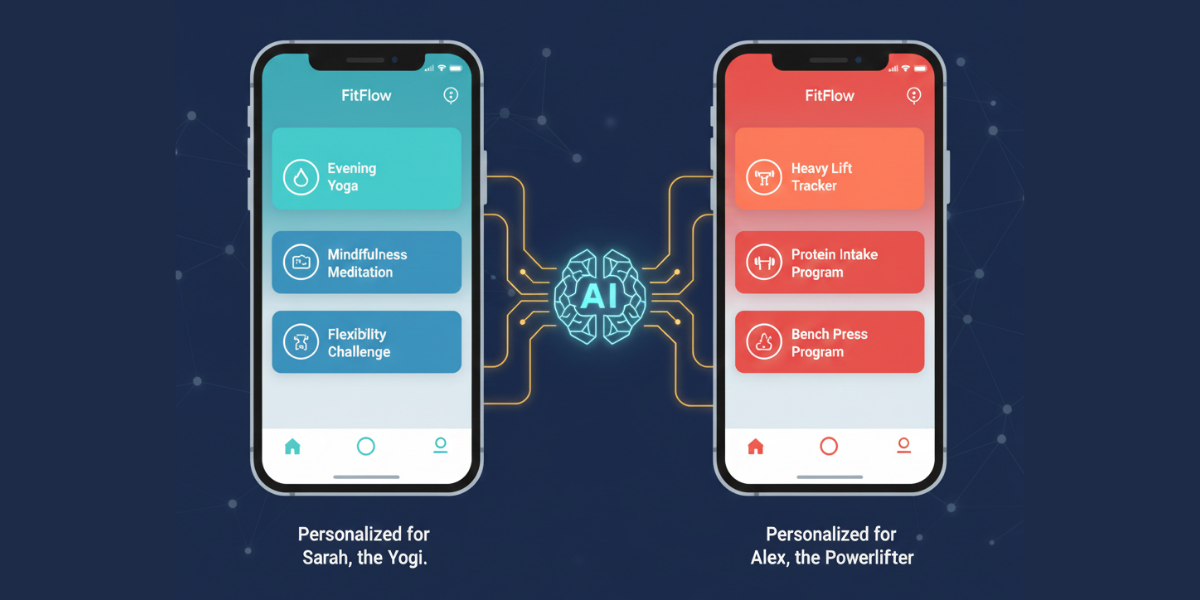
This is where AI-powered personalization moves from a nice welcome to a fundamental utility. The app’s layout, content, and features themselves become dynamic.
- How it Works: Machine learning algorithms analyze in-app behavior in real-time—feature usage, scroll depth, common actions—to surface the most relevant content and tools.
- Example: A fitness app notices a user consistently logs yoga sessions in the evening and browses meditation content. It gradually moves the “Evening Yoga” and “Mindfulness” modules to the top of their home screen, while de-prioritizing unused features like “High-Intensity Training.”
- The Impact: Increases daily active use and deepens feature adoption. The app feels like a custom-built tool, not a one-size-fits-all solution.
The Retention Engine: Hyper-Intelligent Push Notifications
This is the area where personalization is most often abused, but when done right, it’s pure magic.
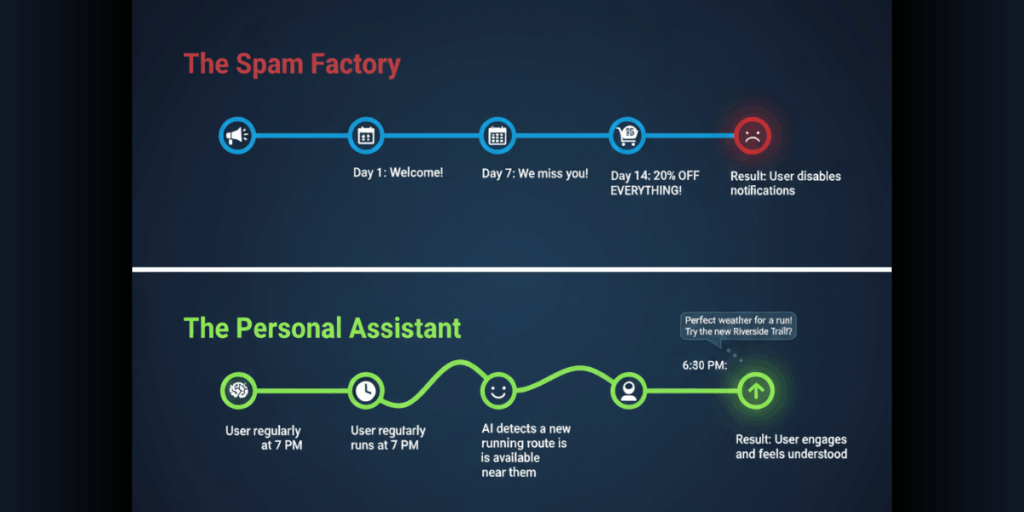
- The Old Way (Broadcast): “Haven’t seen you in a while! Come back and complete a workout!” (Sent to everyone inactive for 7 days).
- The AI-Powered Way (Conversation): “Your favorite instructor, Maria, just released a new 20-minute yoga flow. Ready to unwind?” (Sent to a user who regularly does yoga with Maria, at the time of day they usually work out).
- How it Works: AI analyzes a user’s unique engagement patterns, content preferences, and optimal notification timing to deliver a message that feels personally crafted, not algorithmically blasted.
- The Impact: Skyrocketing open rates and re-engagement, without the annoyance that leads to app uninstalls.
How to Implement a Phased Strategy
Platforms like Google’s Firebase Predictions offer a accessible entry point, using machine learning to predict churn and purchase likelihood. This doesn’t happen overnight. It’s a journey.
- Phase 1: Data Foundation & Segmentation. Instrument your app to collect clean behavioral data. Start with simple rule-based personalization (e.g., segment users by “yoga lovers” vs. “weightlifters”).
- Phase 2: Predictive Modeling. Use an AI platform (like Firebase Predictions, Amazon Personalize, or a custom model) to start predicting user actions, like churn risk or likelihood to purchase.
- Phase 3: Full Experience Personalization. Integrate the AI’s predictions back into the app to dynamically control the UI, content, and messaging in real-time.
The Ethical Core: Personalization with Permission
With great power comes great responsibility. The most effective AI-powered personalization is built on a foundation of trust. This level of data usage must be built on the bedrock principles of Privacy-First Design to maintain user trust.
- Be Transparent: Tell users how you use their data to improve their experience.
- Provide Control: Always include settings to adjust notification frequency or disable personalization features.
- Prioritize Value: Every personalized interaction should provide clear value to the user, not just extract it for the business.
The Bottom Line: From Utility to Indispensability
An app with AI-powered personalization stops being a mere tool and starts becoming an indispensable partner in the user’s life. It learns, adapts, and grows with them. This is the new benchmark for user experience—and the most powerful moat you can build against the competition.
Ready to build an app that doesn’t just serve users, but understands them? Bright Bridge Web specializes in developing intelligent, adaptive mobile experiences.