
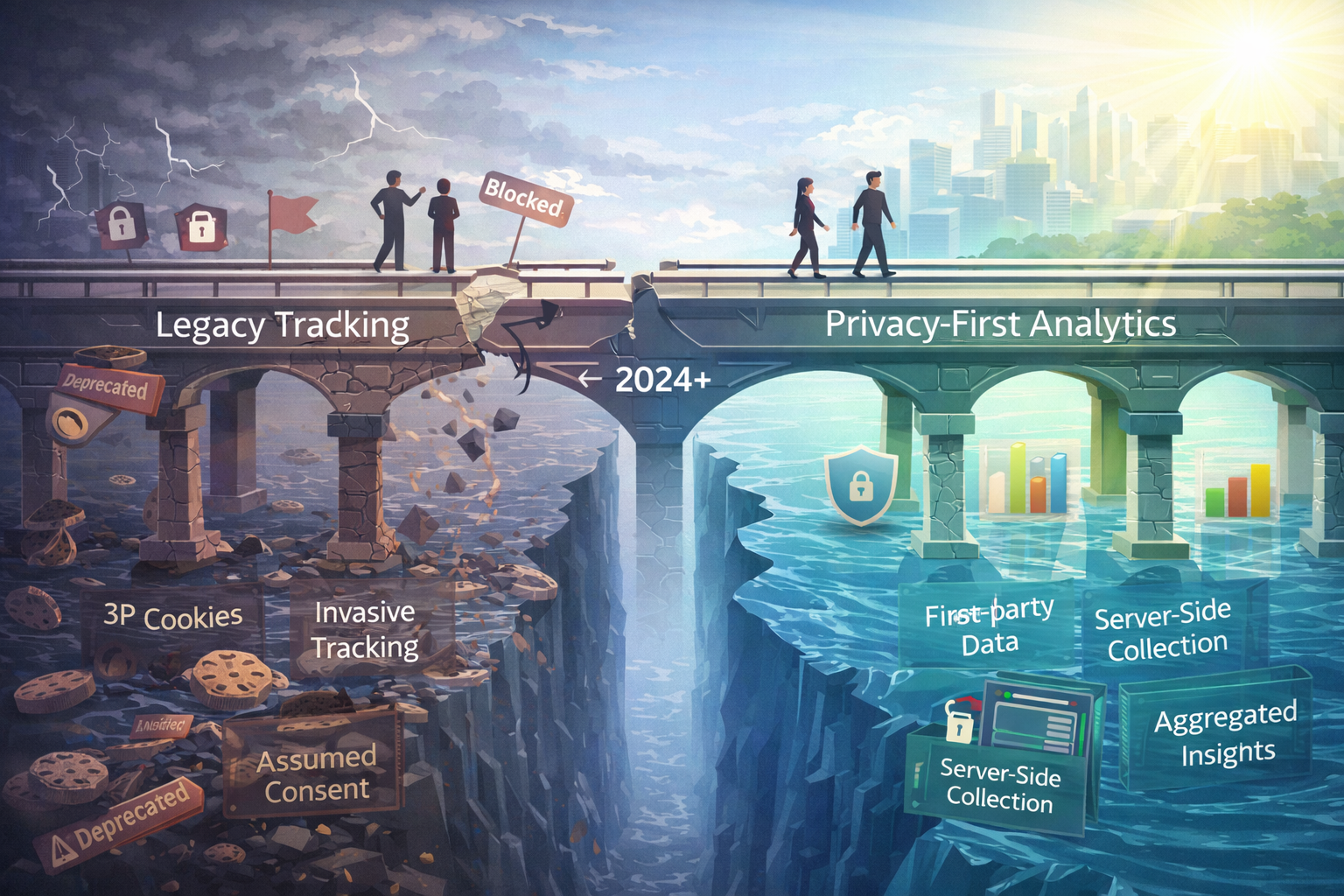
The cornerstone of digital measurement for two decades is crumbling. Third-party cookies, the tiny trackers that enabled cross-site user profiling and retargeting, are being phased out by browsers and regulated into obsolescence by privacy laws. This isn’t an inconvenience; it’s a fundamental reset. The future belongs to cookieless tracking, demanding a complete reimagining of how we collect, process, and derive value from data. Successfully navigating this shift is the challenge of building robust analytics in a privacy-first world—a world where respect for the user is not a constraint, but the foundation of sustainable insight.
The Great Unwinding: Why the Old Model Is Unsustainable
For years, the digital ecosystem operated on a Faustian bargain: free content and services in exchange for pervasive, often invisible, data collection. However, rising user awareness, browser-level changes (like ITP and Chrome’s deprecation), and regulations like GDPR and CCPA have shattered this model. Consequently, the granular, individual-level tracking that powered hyper-personalized ad targeting is becoming technically impossible and legally perilous. Therefore, clinging to legacy cookie-based methods is a path to data poverty. This paradigm shift forces marketers and analysts to adopt methods that are transparent, consensual, and privacy-by-design.
Principles of the Privacy-First Paradigm
Building effective analytics in a privacy-first world is not about finding loopholes; it’s about embracing new core principles that align with user expectations and regulatory frameworks.
- Shift from Individual to Cohort-Based Insights: Instead of tracking a single user across the web, the future is aggregated, anonymized analysis. Technologies like Google’s Privacy Sandbox propose grouping users with similar interests into cohorts for advertising. For analytics, this means focusing on trends, patterns, and segment behaviors rather than stitching together individual clickstreams. The question changes from “What did John Doe do?” to “What do users interested in sustainable gardening typically need?”
- Prioritize First-Party Data with Explicit Consent: Your own direct customer relationships are now your most valuable asset. This involves building transparent value exchanges—newsletters, loyalty programs, account creation—where users willingly provide data in return for a better experience. Consent management platforms (CMPs) become critical, not just for compliance, but for fostering trust. Every data point in your cookieless tracking strategy should be earned, not assumed.
- Embrace Server-Side and Zero-Party Data: Technical architecture must evolve. Server-side tagging (via tools like Google Tag Manager Server-Side) moves data collection from the vulnerable browser to your controlled server, enhancing accuracy and privacy. Furthermore, zero-party data—information a user intentionally and proactively shares (e.g., preference centers, surveys)—becomes a gold standard. It is accurate, consented, and rich with intent.
- Measure What Matters: Outcomes Over Creepy Surveillance: Rather than trying to record every microscopic interaction, focus on key business outcomes tied to consented user journeys. Strengthen your measurement of modeled attribution, incrementality testing, and marketing mix modeling. In a privacy-first world, the signal may be noisier, so aligning analytics tightly to commercial goals (conversions, lifetime value, retention) is paramount.
Building a Future-Proof Analytics Stack
Adopting a cookieless tracking framework requires strategic investment in new tools and mindsets.
- Audit and Simplify Your Data Collection: Ruthlessly evaluate every tag and tracker. Does it serve a critical business function? Can its goal be achieved with aggregated or server-side data? Reduce your data footprint to only what is essential and consented.
- Invest in Identity Resolution (Where Consented): For logged-in users, authenticated first-party IDs (email, user ID) can enable a rich, consented cross-channel view within your own ecosystem. Solutions like Customer Data Platforms (CDPs) become central for unifying this consented data.
- Leverage AI and Predictive Modeling: As deterministic data diminishes, probabilistic models will fill gaps. Use machine learning to analyze aggregated patterns, predict churn, or attribute value across touchpoints in a privacy-safe manner.
- Champion a Culture of Privacy: This transition is not just a technical fix. It requires aligning legal, marketing, and product teams around the principle that ethical data use is a competitive advantage that builds long-term customer trust.
Conclusion: Analytics Built on Trust, Not Tracking
Ultimately, the end of third-party cookies is not the end of analytics. It is the beginning of its maturity. Cookieless tracking challenges us to be more thoughtful, more strategic, and more respectful in how we understand our audiences. By building analytics in a privacy-first world, we move from a model of covert extraction to one of transparent value exchange. In the end, the most sustainable and insightful analytics will be those that users knowingly participate in, because they trust that their data is used to improve their experience—not just to follow them around the web. This is the foundation of the next era of digital business.