
The Need for Speed: How Edge Computing is Killing Latency
You click a link. You wait. A millisecond. Another. Another. By the time the page loads, you’ve already made a judgment. Too slow? You’re gone.
Latency is the silent killer of digital experiences. It’s the gap between action and response. And for decades, we’ve accepted it as an unavoidable fact of physics.
But what if that gap could disappear? What if the distance between user and server could shrink to nothing?
That’s the promise of Edge Computing —a paradigm shift that’s systematically reducing latency to near-zero levels. At Bright Bridge Web, we’re deploying edge architectures that make speed invisible and experiences instant.
The Latency Problem, Explained Simply
Every time a user makes a request, data travels. From their device, across the internet, to a central data center, back to their device. The farther that distance, the longer the wait.
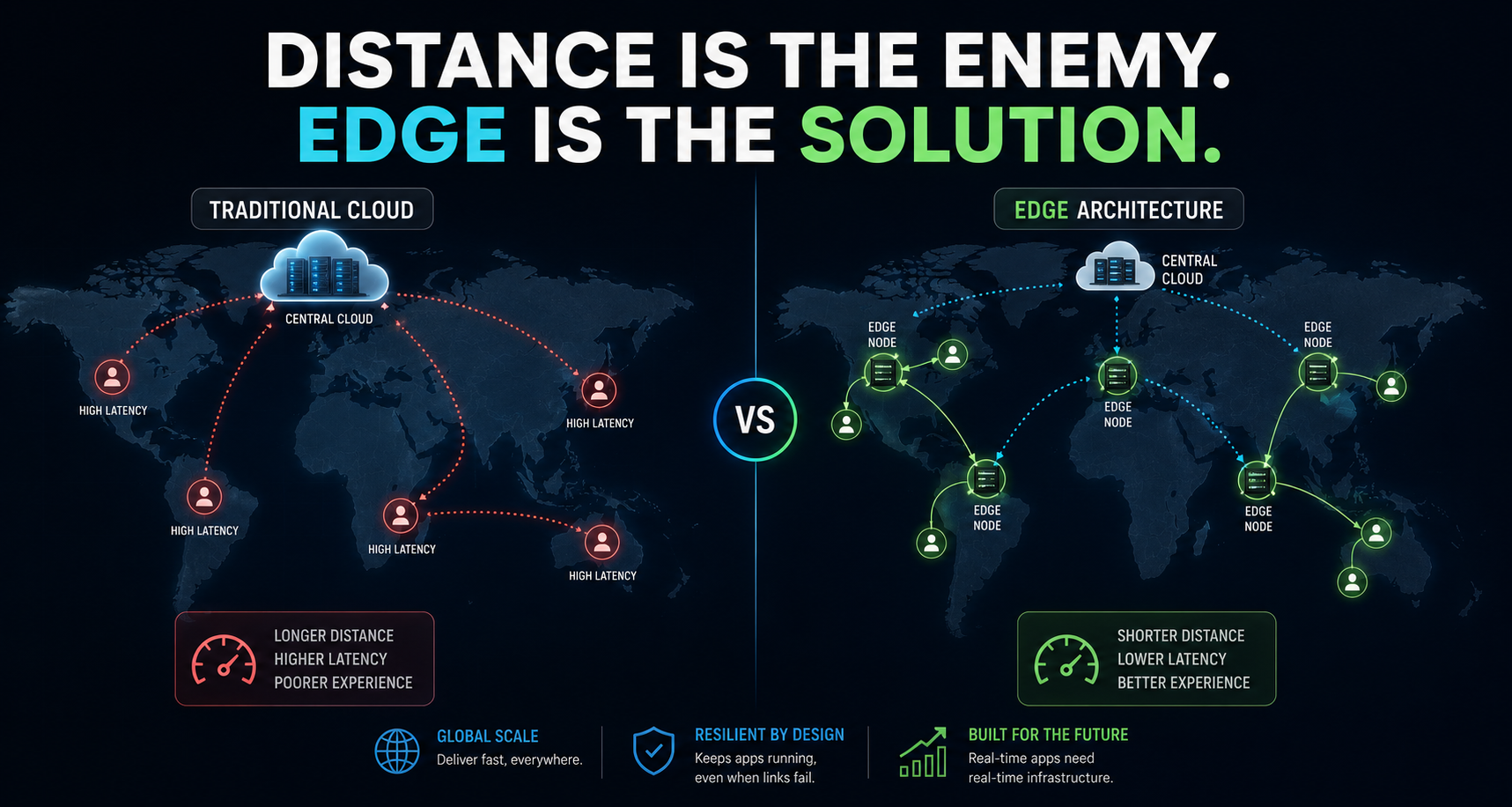
Traditional cloud computing consolidates resources in massive, centralized data centers. Efficient for the provider. Slow for the user in Singapore accessing a server in Virginia.
Edge Computing flips this model. Instead of one central location, you deploy thousands of distributed “edge locations” closer to users. The request travels a few miles instead of thousands. Milliseconds become microseconds.
The Three Types of Latency Edge Computing Eliminates
1. Network Latency (The Distance Problem)
This is the time it takes for data to physically travel. Speed of light is fast, but not instant. A round trip from New York to Sydney takes over 200 milliseconds just in transit.
Edge solution: Deploy compute in every major city. Users connect to the nearest edge location. Network latency approaches zero.
2. Processing Latency (The Computation Problem)
Once data arrives, the server must process it. Traditional architectures process everything centrally, creating bottlenecks.
Edge solution: Distribute processing to the edge. Compute happens close to the user. The central cloud coordinates but doesn’t execute every request.
3. Idle Latency (The Cold Start Problem)
Serverless functions can be slow to start if inactive. The first user after a pause waits for the infrastructure to spin up.
Edge solution: Edge functions stay warm globally. No cold starts. Instant response every time.
What Becomes Possible at Near-Zero Latency
Real-Time Collaboration
Google Docs was a miracle. But imagine: hundreds of cursors moving simultaneously, zero lag, perfect sync. Edge computing makes distributed real-time collaboration indistinguishable from local.
Immersive Experiences
AR/VR demands sub-10ms latency to prevent motion sickness. Central cloud can’t deliver that reliably. Edge can. The metaverse requires edge.
Autonomous Systems
Self-driving cars, drones, and robotics can’t wait for a round trip to a central server. Decisions must happen locally but coordinate globally. Edge provides the bridge.
Personalization at Scale
Hyper-personalization requires real-time data processing. Edge computing analyzes user behavior and serves tailored experiences without perceptible delay.
How to Implement Edge Computing
1. Choose Your Edge Platform
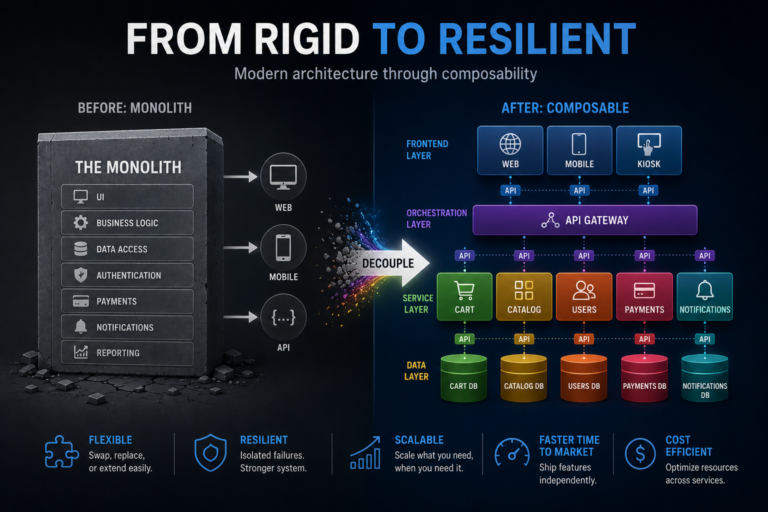
Edge fits naturally within composable architecture , with each component deployable independently. The major players offer different approaches:
- Cloudflare Workers: Massive global network, excellent developer experience, generous free tier
- Vercel Edge Functions: Tight Next.js integration, CDN-first architecture
- Netlify Edge Functions: Built on Deno, good for existing Netlify users
- AWS Lambda@Edge: Deep AWS integration but more complex
- Fly.io: Global VMs, good for stateful applications
2. Rethink Your Data Strategy
The hardest part of edge computing isn’t compute—it’s data. Your database is still centralized.
Solutions:
- Edge caching: Cache reads at the edge, write to central
- Edge databases: Fly.io, Fauna, or Turso offer distributed data
- Data localization: Keep user data in their region
- Eventual consistency: Accept temporary inconsistencies for speed
3. Deploy Gradually
Start with static assets (already at the edge via CDN). Add edge functions for simple logic. Move to edge databases for stateful needs. Not everything needs the edge.
4. Optimize Cold Starts
Edge functions generally avoid cold starts, but if you experience them:
- Keep function bundles small
- Reduce dependencies
- Use warmer mechanisms if available
- Consider regional persistence
Real-World Edge Success Stories
E-Commerce Checkout
A global retailer moved checkout validation to the edge. Previously, a user in Australia waited for a US server to verify inventory. Now, edge functions in Sydney validate against cached inventory data. Checkout time dropped from 800ms to 80ms. Cart abandonment decreased 15%.
Personalized News Feed
A media company moved personalization to the edge. User preferences are cached locally. Content recommendations are computed at the edge based on cached profiles. Feed loads in 50ms instead of 400ms. Engagement increased 25%.
Real-Time Analytics
A gaming company moved event processing to the edge. Player actions are aggregated at edge locations, then sent to central storage in batches. Dashboard updates feel instant. Infrastructure costs dropped 40%.
The Limits (Honest Talk)
Edge Computing isn’t magic. It won’t solve every problem.
- Write-heavy workloads: Edge caching helps reads, not writes
- Complex transactions: Distributed consistency is hard
- Heavy computation: Edge has less CPU than central cloud
- Data gravity: Some data can’t leave the central database
Choose what moves to the edge wisely. Not everything benefits equally.
The Future: Edge-First Architecture
We’re moving toward an edge-first world where central cloud becomes the backup, not the default. Applications are designed assuming edge execution, with central coordination for what edge can’t handle.
This shift will take years, but it’s accelerating. Every major cloud provider is investing heavily in edge. Every new framework prioritizes edge deployment. The physics of speed demand it.
The Bottom Line: Speed is a Feature, Not a Luxury
Users expect instant. They’ve been trained by the fastest experiences on the web—Google search, TikTok, Amazon. Anything slower feels broken.
Edge Computing makes instant possible for everyone, not just the giants with infinite resources. It democratizes speed.
The question isn’t whether you’ll adopt edge computing. It’s whether you’ll adopt it before your competitors do.