

For decades, SEO meant one thing: keywords. Find the right phrase, use it the right number of times, and watch your rankings climb. But search engines have grown up. They no longer just match strings of text; they attempt to understand concepts, relationships, and meaning.
This shift is the foundation of Entity-Based SEO—an approach that moves beyond individual keywords to focus on entities, topics, and the connections between them. At Bright Bridge Web, we’ve watched this evolution transform how Google evaluates content, and we’re here to help you adapt.
What is an Entity?
In simple terms, an entity is a distinct, well-defined thing or concept. It could be a person (“Taylor Swift”), a place (“Paris”), an organization (“Red Cross”), a product (“iPhone 15”), or even an abstract concept (“Climate Change”).
Google’s Knowledge Graph—introduced over a decade ago—contains millions of these entities and the relationships between them. The algorithm knows that “Taylor Swift” is connected to “Singer,” “Songwriter,” “Eras Tour,” and “Pop Music.” It understands context.
Entity-Based SEO is the practice of aligning your content with this entity-driven understanding of the world.
Why Keywords Alone No Longer Cut It
Keywords are still important, but they’re the tip of the iceberg. Here’s what Google is really doing when it evaluates your content:
- Understanding Context: Does your content prove you understand the broader topic, or just that you can repeat a phrase?
- Mapping Relationships: Can Google connect your content to relevant entities in its Knowledge Graph?
- Assessing Authority: Are you a recognized source on the topic, not just a page targeting a keyword?
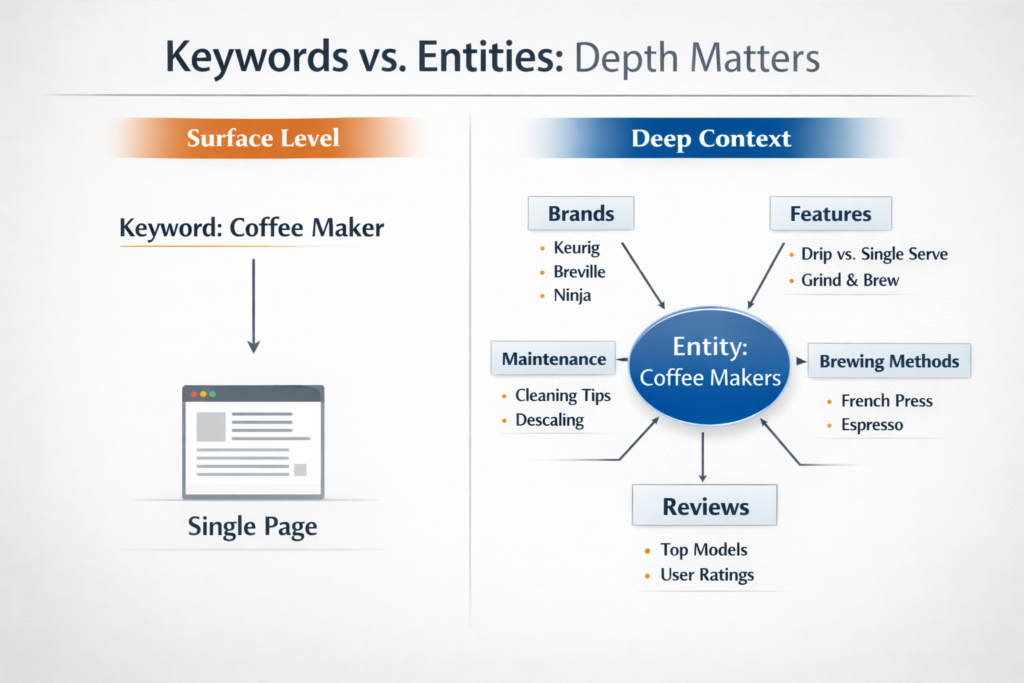
If you’re still writing content that simply repeats “best coffee maker” twenty times, you’re missing the point. Google wants to see that you understand coffee makers—the brands, the features, the buying considerations, the maintenance tips. That’s Entity-Based SEO.
How to Implement an Entity-Based SEO Strategy
1. Think in Topics, Not Keywords
Stop building content around isolated keywords. Start building content clusters around core topics.
- Old Way: Write a page targeting “leather boots.”
- Entity-Based Way: Create a resource hub on “leather footwear” that covers boot styles, care instructions, top brands, sizing guides, and material comparisons.
This signals to Google that you are an authority on the entity of “leather boots,” not just a page that happened to use the phrase.
2. Leverage Structured Data (Schema Markup)
Schema markup is the language you use to speak directly to Google’s entity-based understanding. It explicitly defines what your content is about.
- Use
Productschema for e-commerce items - Use
ArticleorBlogPostingschema for your content - Use
OrganizationorPersonschema to define your brand - Use
HowToschema for instructional content - Use
FAQPageschema for question-based content
This structured data helps Google connect your content to the right entities in its Knowledge Graph.
3. Build Topical Authority Through Internal Linking
Entity-based SEO rewards websites that demonstrate deep knowledge on a subject. Your internal linking structure should reflect this.
- Create pillar pages on broad topics
- Link to detailed cluster pages that explore specific aspects
- Use descriptive, entity-rich anchor text
A well-structured site tells Google, “This domain comprehensively understands this entity.”
4. Optimize for Related Entities
If your core topic is “digital marketing,” what related entities should you cover?
- Sub-entities: SEO, Content Marketing, Social Media, PPC
- Associated people: Seth Godin, Neil Patel, Rand Fishkin
- Tools: Google Analytics, HubSpot, SEMrush
- Concepts: Conversion Rate, Brand Awareness, ROI
When you naturally incorporate these related entities, you reinforce your authority on the core topic.
5. Answer Questions Thoroughly
Google’s entity-based understanding thrives on question-and-answer relationships. Use tools like “People Also Ask” and “AlsoAsked.com” to identify the questions surrounding your core entity.
Create content that directly, comprehensively answers these questions. Each answer strengthens Google’s understanding of your expertise.
This question-based approach also powers effective Voice Search Optimization , where conversational queries dominate.
The Role of E-E-A-T in Entity-Based SEO
Google’s emphasis on Experience, Expertise, Authoritativeness, and Trustworthiness (E-E-A-T) aligns perfectly with Entity-Based SEO.
When you build content that demonstrates deep, connected knowledge, you signal E-E-A-T. When you cite authoritative sources, include author bios, and link to reputable external entities, you reinforce trust.
The Bottom Line: Keywords are Dying; Long Live Entities
The future of search belongs to those who understand that Google isn’t just reading words—it’s trying to understand the world. Entity-Based SEO is the practice of making your content comprehensible to this new, more intelligent search landscape.
Stop writing for keywords. Start writing for entities. Build content that demonstrates genuine, connected expertise. Your rankings—and your users—will thank you.
Ready to future-proof your SEO strategy? At Bright Bridge Web, we build content architectures designed for entity-based search.