

Remember when the browser existed solely for documents? You’d load up simple pages, fill out basic forms, or maybe watch a Flash animation if you were feeling particularly adventurous. Fast forward to today, and suddenly we’re asking browsers to run video editors, 3D games, CAD software, and complex data visualization tools. That’s quite a leap.
The problem, however, is that JavaScript—the native language of the web—was never actually built for any of this. Don’t get me wrong: it’s powerful and incredibly flexible. Nevertheless, it has real limits. That’s precisely where WebAssembly (Wasm) enters the picture. As a low-level, binary instruction format that runs in the browser at near-native speed, it brings desktop-class performance directly to the web.
At Bright Bridge Web, we’ve been closely watching how WebAssembly (Wasm) transforms what’s possible online. So, why does it matter? And how is it changing the game? Let’s dig in.ne. Here’s why it matters and how it’s changing the game.
What Exactly is WebAssembly (Wasm)?
Think of WebAssembly (Wasm) as an entirely new type of code that runs right alongside JavaScript inside your browser. Importantly, it’s not a language you’d write directly. Instead, you write code in languages like C, C++, Rust, or Go, and then compile it into Wasm modules. After that, the browser executes those modules at lightning speed. For comprehensive documentation and specifications, the official WebAssembly website is an excellent resource.
The key advantages are hard to ignore:
- Near-Native Performance: Wasm runs at speeds comparable to traditional desktop applications.
- Language Agnostic: You can use the best language for the job, not just JavaScript.
- Secure: It runs inside a sandboxed environment with the same security policies as JavaScript.
- Portable: Works seamlessly across all major browsers on virtually any device.
What WebAssembly (Wasm) Makes Possible
1. Complex Web Applications, Now Actually Feasible
Before Wasm, building a video editor inside a browser was essentially a pipe dream. Now? Consider Figma. The company rebuilt its rendering engine with Wasm and saw load times improve by 3x. Similarly, Adobe brought the full Photoshop experience to the web. Furthermore, AutoDesk now runs CAD software comfortably inside a browser tab.
2. High-Performance Gaming Without Plugins
Game engines like Unity and Unreal Engine now compile directly to WebAssembly (Wasm) . As a result, they deliver console-quality gaming experiences without any plugins. Users simply click a link and start playing—no downloads, no installers, and absolutely no friction.
3. Data Visualization and Scientific Computing
Processing massive datasets, running complex simulations, or rendering detailed visualizations used to require heavy desktop software. With Wasm, however, these tasks happen instantly inside the browser. Consequently, data becomes accessible to anyone with a simple link.
4. Breathing New Life Into Legacy Code
Companies sitting on millions of lines of C++ or C code can now bring that functionality to the web without rewriting everything from scratch in JavaScript. By compiling to Wasm, a legacy application transforms into a modern web app almost overnight.
How WebAssembly (Wasm) Works
The workflow itself is surprisingly straightforward:
- Write: Develop your performance-critical code in C, C++, Rust, or another supported language.
- Compile: Use a tool like Emscripten or the Rust compiler to generate a
.wasmfile. - Load: Your JavaScript loads the Wasm module and then interacts with it.
- Execute: Finally, the browser runs the Wasm code at near-native speeds.
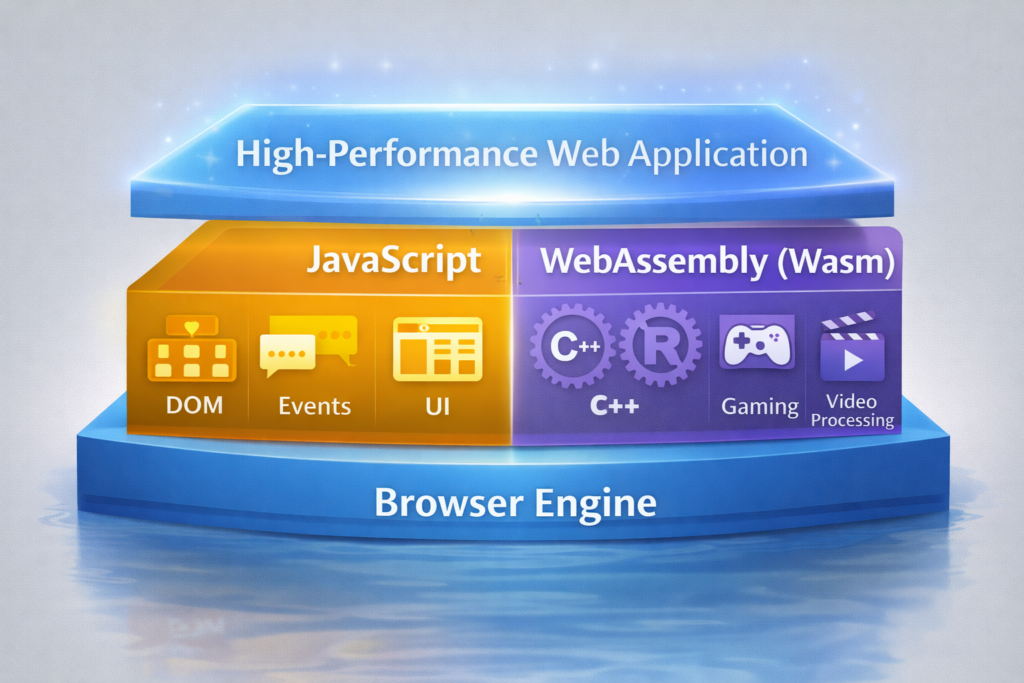
Notice that JavaScript and Wasm work together rather than competing. JavaScript handles DOM manipulation and user interactions, while Wasm tackles all the heavy lifting behind the scenes.
Real-World Success Stories
Figma: By replacing their browser-based rendering engine with Wasm, Figma reduced load times by 3x. Moreover, they enabled smoother and more complex design interactions than previously possible.
Google Earth: The original Google Earth required a full desktop download. Today, the web version—powered by WebAssembly (Wasm) —runs directly in your browser while delivering the same smooth, 3D experience.
eBay’s Barcode Scanner: eBay built a barcode scanner for their web app using Wasm. The result? Performance that would have been completely impossible with JavaScript alone.
The Limitations (Nothing’s Perfect)
Of course, WebAssembly (Wasm) isn’t a magic bullet. You should be aware of a few limitations:
- DOM Access: Wasm can’t directly manipulate the DOM; it always needs JavaScript as a bridge.
- Startup Overhead: Large Wasm modules can take noticeable time to initialize.
- Garbage Collection: Not yet natively supported, although this feature is coming soon.
- Debugging: Still maturing compared to JavaScript’s robust developer tools.
The Future of WebAssembly (Wasm)
The ecosystem around Wasm is evolving rapidly. In fact, several exciting features are on the horizon:
- Garbage Collection: This will make languages like C# and Java much more viable on the web.
- Threading: True multi-threading support will deliver even better performance for complex tasks.
- Component Model: Expect easier sharing and composition of Wasm modules across projects.
- WASI (WebAssembly System Interface): This will allow running Wasm outside the browser—on servers and edge devices.
Speaking of edge computing, with WASI, Wasm modules can run at the edge as well. Therefore, they complement the distributed architecture of edge computing beautifully.
The Bottom Line: A New Era for the Web
Let’s be clear: WebAssembly (Wasm) does not replace JavaScript. Instead, it complements it perfectly. JavaScript remains the language of the web for user interaction and DOM manipulation. But for performance-critical tasks—the heavy lifting that slows everything down—Wasm is unquestionably the future.
We are now entering an era where the browser becomes a first-class platform for any application imaginable. Whether you’re building games, productivity suites, or scientific tools, the line between desktop and web is blurring fast. And WebAssembly (Wasm) is driving that change more than anything else.
Ready to explore what Wasm can do for your next project? At Bright Bridge Web, we’re already building high-performance web experiences that push the boundaries of what’s possible online. Let’s talk.